
The glossary
The words we use.
We send the session out before you get to the pool, so you arrive knowing what you are swimming and why. That only works if the words on it mean something to you. Here is the whole board, in plain language, starting with how to read a workout.
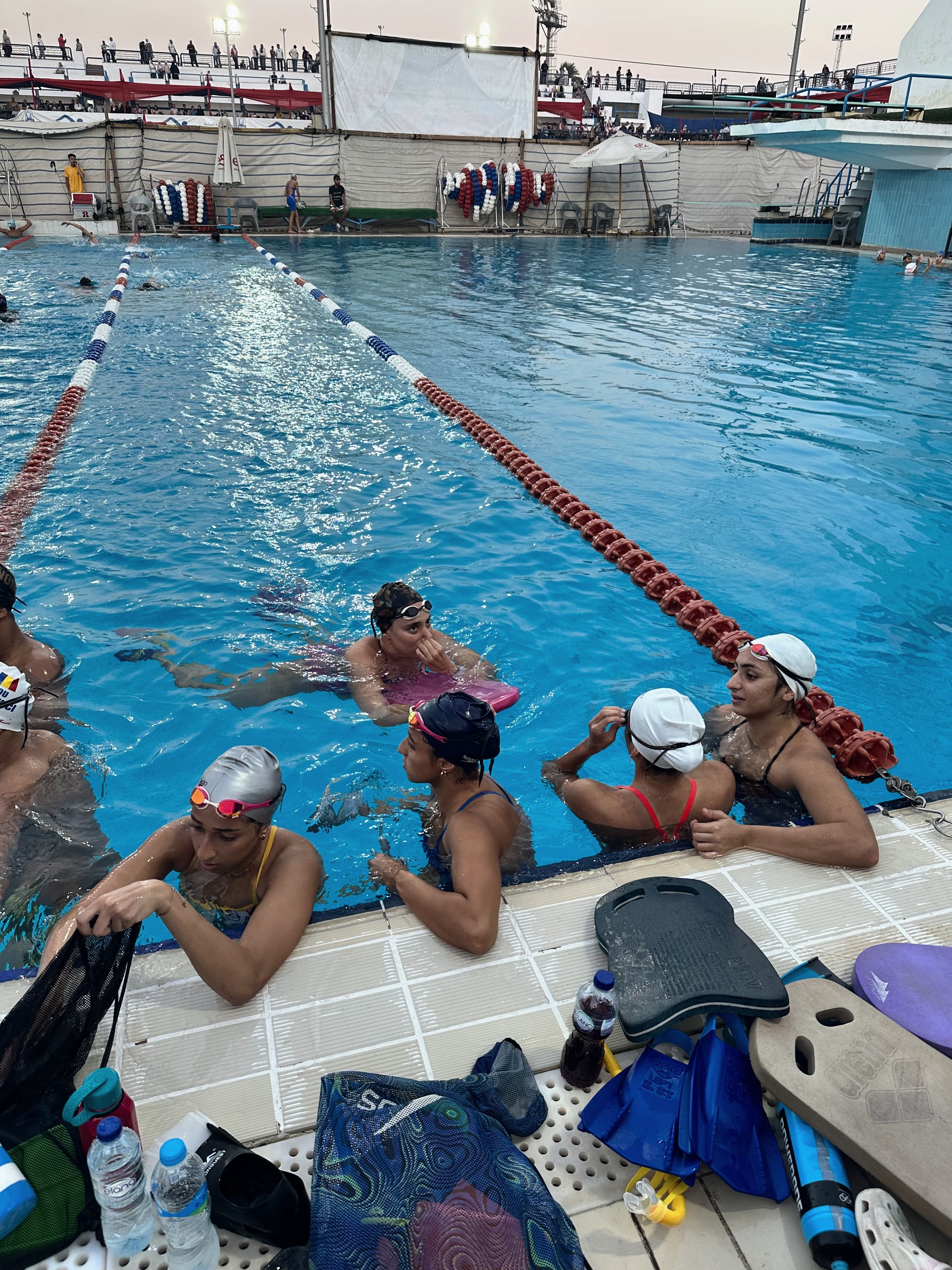
How to read a workout
A typical Saturday
Every underlined word below is in the glossary further down. The line under each block is what that stretch of swimming is actually for.
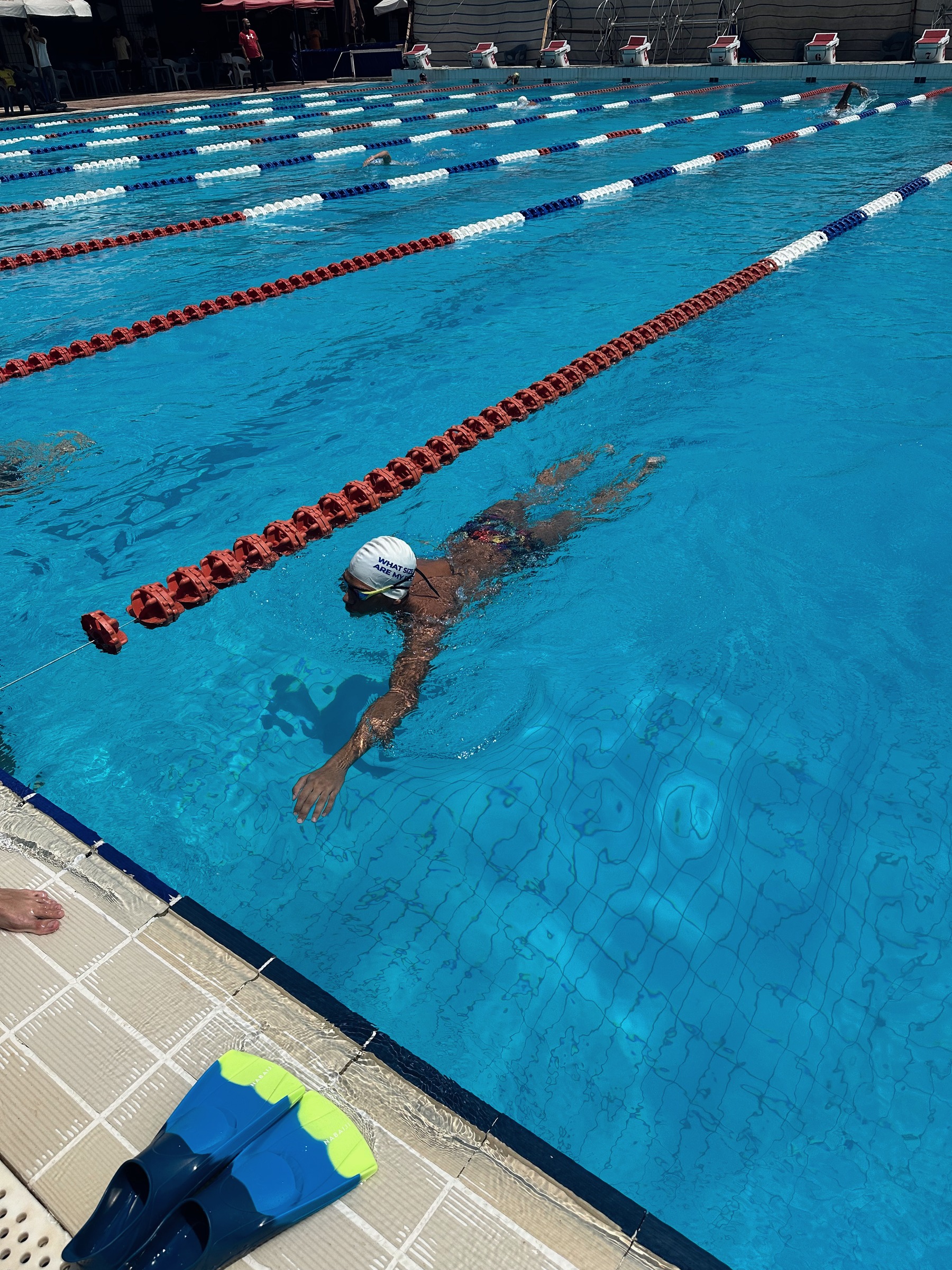
Warm up
600mFins let you feel a fast body position before you have to hold one yourself. The shoulders get warm on someone else's speed.
Water-feel activation
400m4 × 50 @ 1:15, 25 scull + 25 smooth swim, hold the water through the catch
4 × 25 @ 0:45, build 1 to 4, long strokes and clean pressure
4 × 25 @ 0:45, quick hands, firm catch, relaxed speed
Your feel for the water is different every day. We find out what today's is before the main set asks anything of it.
Starts and underwaters
200mIn the last two weeks before a meet, starts, turns and finishes are still improving when nothing else is. They are the cheapest seconds in the sport.
Main set, part one
RED 300m · BLUE 450mEach round = 3 × 50, all 50s @ 2:00
1 × 50 off the blocks, front-end speed
2 × 50, back-end speed
RED 2 rounds · BLUE 3 rounds
A race has two problems: getting up to speed, and still having it at the end. This set works them in the order the race meets them.
Main set, part two
RED 200m · BLUE 300mTen seconds inside the hundred lets you hold race speed for the whole distance. You find out what the swim could feel like before you are fit enough to swim it that way.
Cool down
500m500 easy
What the main set left in your arms comes out here or it comes out tomorrow.
Why the week looks like this
Every day has a job.
No session exists on its own. The order matters more than any one set in it.
- FriQuality 1The hardest day of the week. It follows the day off, so it gets a fresh swimmer.
- SatQuality 2Hard again, on a different system to Friday. That is what makes back-to-back quality days safe.
- SunActive recoverySkills, starts, finishes, one touch of race pace. This day is never upgraded, however good you feel.
- MonQuality 3Speed and race pace. Broken swims, dive 50s, the sharp end of the week.
- TueLightLow volume, some speed, full rest. Sharpening before the trial.
- WedTime trialOne or two events per swimmer, from the blocks, timed, splits recorded.
- ThuOffNothing. The week is built around this as much as around Wednesday.
- The week runs backwards from Wednesday. Tuesday and Sunday give the trial two easy days out of the previous three, which is what produces a time worth writing down.
- The heaviest lactate work sits on Friday, five clear days from the next trial. Put it the day before and you race on yesterday's acid every single week.
- The trial replaces a hard set. It never adds one.
- Extra distance only ever goes into Sunday and Tuesday, and only as easy aerobic metres. The intensity of those days stays where it is, so they keep doing their job.
Reading a workout
Enough to read any set on the board without asking.
- Set
- A piece of the session with one instruction attached, like 8 × 50 @ 1:15. A session is a handful of sets in an order that has a reason behind it.
- Rep
- One piece of a set. In 8 × 50 each fifty is a rep, and you have eight of them.
- ×
- Reps by distance. 8 × 50 means eight fifties: the first number is how many, the second is how far.
- @
- The interval, meaning the clock you leave on. 8 × 50 @ 1:15 starts a new fifty every minute and fifteen, so swimming faster buys you more rest rather than less work.
- Round
- A group of reps repeated as a unit. Three rounds of 3 × 50 is nine fifties, with the rest sitting between the rounds instead of inside them.
- Block
- One named part of a session, like the warm up or the main set. The name tells you what that stretch of swimming is for.
- Break
- Time out of the water between blocks, written in minutes. It is part of the session, so take all of it.
- Warm up
- The first block. Gets your body ready to work and your hands ready to feel the water.
- Cool down
- The last block, swum genuinely easy. It clears what the main set left behind, and skipping it costs you the next day.
- Main set
- The part of the session the day is built around. The coach tells you what it is for before you swim it.
- Drill set
- A set named for what you do in it rather than how hard you go. Kick sets and pull sets work the same way.
- w/
- Short for with. 300 free (w/ fins) means swim it wearing fins.
- Choice
- Your pick of stroke. It shows up on easy swimming, where the point is to keep moving.
- Easy
- Genuinely easy. If you could hold a conversation halfway down the length, you have it about right.
- Odd / even
- Instructions that alternate by rep number. Odds do one thing, evens do the other.
- On one clock
- Both groups leave on the same pace clock even when their distances differ, so nobody waits around for a start of their own.
- Volume
- How far you swim, counted in metres. Sessions are quoted as a total, and each group has its own.
- AM / PM
- Two sessions in one day. The evening one is usually shorter and sharper.
How a set is shaped
The same distance can be twenty different sessions. This is how we say which one.
- Build
- Descend
- Ascend
- Broken swim
- Back-half scored
- Build
- Start controlled and get faster as you go. Build 1 to 4 means the fourth rep is the quickest of the four.
- Descend
- Each rep faster than the one before it. Descending is a promise you make on the first rep, so leave yourself somewhere to go.
- Ascend
- Each rep slower than the last. Used when the point is to add distance without adding speed.
- Broken swim
- A race distance swum in pieces with a few seconds rest inside it. A 100 broken at 50 is fifty, ten seconds, fifty.
- Broken target
- What the pieces of a broken swim should add up to. It sits under your best time for that distance, because the rest inside is worth about a second.
- Front-end speed
- How fast you get off the blocks and up to racing speed. Trained with dives, and it is the half most swimmers leave alone.
- Back-end speed
- How fast you still are when the race is nearly over. Trained on tired legs, deliberately.
- Back-half scored
- Only the second half of the swim counts. It stops you buying a good total with a fast first length.
- Benchmark
- A set that comes back through the season swum exactly the same way, so the times can be put side by side. Same distance, same rest, same order.
- Time trial
- A full race from the blocks, timed, filmed, with splits taken. We run one for the whole team every Wednesday, all year.
- Controlled failure
- A set you are meant to run out of on purpose, with a rule that stops you the moment you do. It finds your edge without spending the rest of the week.
- Stop-rule
- The condition that ends a round early. Two fifties more than 0.8 off target and the round is over. A stopped round counts as a completed round and nobody makes it up.
- The fade
- Sets built around what happens when your speed starts to leave. The aim is to make it arrive later.
- Max speed
- Everything you have, with full rest and no target time. We write down the number rather than chase one.
- Alactic
- Very short efforts with long rest, quick enough that nothing burns. Any burn means the rest was too short, so widen the interval rather than push through.
- Dive 50s
- Swum from a racing start instead of a push off the wall. Worth roughly a second, and it is how the race actually begins.
- Off the blocks
- From a racing start, on the whistle, the way you would at a meet.
- Race-pace touch
- One short piece at race speed inside an otherwise easy day. Keeps the feel without costing you the recovery.
- Test set
- A set repeated across a season to measure change. Swim it in March and again in June and the two times mean something next to each other.
- Pace name
- A target written as a race rather than a number. 100 pace means the per-50 speed your best 100 implies, converted into seconds before the session and put on the board.
- Even split
- Both halves of a swim at the same speed. It is harder than it looks and usually quicker than going out hard.
- Negative split
- Swimming the second half faster than the first. Harder than it sounds, and usually the plan.
Effort and energy
Why two sets of the same length can have nothing to do with each other.
- EN1
- Easy aerobic swimming. It builds the base everything else sits on, and it should feel like you could keep going for a long time.
- EN2
- Steady aerobic work, comfortably hard. Roughly the pace you could hold all session if someone made you.
- EN3
- Hard aerobic work, close to where holding the pace starts to hurt. This is the engine room.
- Threshold
- The quickest pace you can hold before the burn takes over. It sits between EN2 and EN3, and most of your aerobic gains live there.
- Speed endurance
- Holding near-race speed after it has stopped being comfortable. Usually 75s and 100s with real rest between them.
- Lactate tolerance
- Work that deliberately brings on the burn so you learn to hold your stroke together while it happens.
- Aerobic power
- Hard sustained work that lifts the ceiling on what you can hold. Sits at the top of EN3.
- Sprint
- All out, full rest, no pacing. The only instruction is everything you have.
- Active recovery
- Easy swimming that helps you recover better than sitting on the side would. A recovery day is never upgraded, however good you feel that evening.
- Loosen
- A short easy swim between races or after a hard effort, to get your arms back.
- Quality day
- A day built around one hard set where the times matter. We run three a week.
- Light day
- Low volume, a little speed, full rest. It sharpens without taking anything.
- Load
- How much of a normal session you are doing, written as a percentage. A swimmer close to a meet might be at 55%.
- Kick durability
- Kick work long enough that your legs are still there at the finish.
- Resisted power
- Swimming against something, usually a band, parachute or power cord, to make the water heavier than it is.
- Water feel
- How much water your hands and forearms can actually hold. It changes day to day, which is why every session goes looking for it early.
The season
How the year is put together, and why your week looks the way it does.
- General prep
- Specific prep
- Taper
- Peak
- Microcycle
- One week of training, planned as a single unit. Ours is built backwards from Wednesday.
- General prep
- The block where volume is highest and no meet is close. The fitness that carries a whole season gets built here.
- Specific prep
- The block before a meet, where the training starts to look like the race.
- Periodisation
- Planning the season in blocks so the hard work lands early enough to be absorbed and the speed shows up on the right day.
- Taper
- The rest period before a big meet, when training drops and the speed appears. The hardest part is trusting it.
- Deep taper
- The largest cut of all, for the swimmer whose race is closest.
- Days out
- How many days until your first race. It sets your load for that day.
- Under-tapered
- Still carrying training fatigue on race day, because we cut your load too little or left it too late. If you feel slow at the end of a taper this is usually why, and the answer is to cut further rather than train more.
- Peak
- The day the whole plan has been pointing at.
- Meet protocol
- The race-day routine: when you warm up, when the suit goes on, what happens between races.
- Marshalling
- The window before your heat when you report and wait. We rehearse it at the Wednesday trial so it is not new to you on the day.
- Volume target
- The weekly distance a group is aiming at. Extra metres go into the easy days, never into the hard ones.
The kit
What you might be asked to bring. Everything here is on the board by name.
- Fins
- Give you more speed than your kick has earned, so you can feel a fast body position and then go looking for it without them.
- Paddles
- Bigger hands. They load the catch and tell you very quickly if your pull is slipping.
- Pull buoy
- Floats your hips so your legs stop working and your arms do everything. Written out in full on the board, because PB already means personal best here.
- Kickboard
- Holds your upper body up so the set is all legs.
- Snorkel
- Takes breathing out of the stroke, so you can work on body line without a breath pulling you off it.
- Band
- A loop round the ankles that stops the kick completely. Everything then depends on the catch.
- Parachute
- Drags behind you and makes the water heavy. Used for power, then taken off so you can feel the speed that arrives.
- Tempo trainer
- A beeper under your cap set to a rate in CPM. You hold your stroke to the beep.
- Ankle weights
- Load the legs and pull the hips down, which makes holding a flat body line much harder work.
- Power cord
- A stretch cord anchored to the wall. You swim against it, or it pulls you back faster than you can swim.
The stroke
The parts of a stroke, and the words a coach uses to fix one.
- Catch
- The first part of the pull, where your hand and forearm take hold of the water. Most of the speed you're missing is hiding here.
- Pull
- The underwater part of the stroke, the part that actually moves you. We film it more than anything else.
- Recovery
- The arm travelling forward above the water. Done well, it costs you almost nothing.
- Streamline
- Arms locked behind the head, body in one tight line off every wall. The fastest you will ever move in water is in this shape.
- Line
- How straight your body stays while you swim. Every bend you carry is drag you pay for.
- Underwaters
- The dolphin kicks off a start or turn, before the first stroke. Races are won and lost down there.
- Breakout
- The moment you surface from the underwater phase into your first stroke. Done right, you carry wall speed into the swim.
- Scull
- Small sideways hand movements that teach you where the water is. Most swimmers find their catch in a sculling drill before they ever find it swimming.
- Hold the water
- Keep pressure on your hand and forearm the whole way through the pull, rather than letting it slip past.
- Quick hands
- A fast front end of the stroke, with no pause once the hand has taken hold.
- Clean pressure
- Even force through the pull, with no snatch at the start and no give at the end.
- Relaxed speed
- Fast without tension. Tight shoulders swim slower, every time.
- High elbow
- Keeping the elbow above the hand through the catch, so your forearm faces backwards and pushes water where you want it to go.
- Rotation
- How far your body rolls with each stroke. It lets you reach further and lets your back do work your shoulder was doing on its own.
- Bilateral
- Breathing to both sides. It keeps your stroke even and means a bad side in a race is not a surprise.
- Breathing pattern
- How often you breathe, written as a number. Every 3 alternates sides; 3/5/7 gets longer as the set goes on.
- Pullout
- The underwater pull and kick off the wall in breaststroke, before you surface.
- Flip turn
- The tumble turn used in freestyle and backstroke.
- Open turn
- The two-hand touch turn used in breaststroke and butterfly.
- Finish
- The last stroke into the wall. You do not glide into it and you do not breathe on it.
- Flags
- The bunting five metres out from each wall. It tells backstrokers where the wall is, and we count your strokes from it.
- Drag
- Everything about your shape that the water is fighting. Cheaper to remove than to power through.
The numbers
What gets measured, and what each number is actually telling you.
- Split
- Your time for one section of a race, like each 50 of a 200. Splits tell us how the race actually went, not just how it ended.
- Stroke rate
- How many strokes you take per minute, written as SR. Faster is not automatically better; it has to match your stroke length.
- Stroke count
- Strokes per length, written as SPL. Fewer strokes at the same speed means you got more out of each one.
- DPS
- Distance per stroke. The efficiency number: how far one stroke carries you.
- CPM
- Cycles per minute, the rate you set a tempo trainer to.
- Pace
- The speed you can repeat, not the speed you can hit once. Most of our sets are built around it.
- Target time
- The number you are trying to hit on a rep. It comes off your own best times, worked out before the session and written on the board.
- RPE
- How hard a swim felt, from one to ten. We log it so easy days actually stay easy.
- PB
- Personal best.
- Breakout distance
- How far off the wall you surface. We measure it, because a metre lost every wall is most of a second in a 100.
- Strokes to the flags
- How many strokes it takes you to cover the last five metres. It tells a backstroker whether their finish will work under pressure.
Race day
The words that only come out at a meet.
- Heat
- One race within an event. Big events run many heats, and your time ranks you across all of them.
- Seed time
- The time you enter a meet with. It decides your heat and your lane.
- Race pace
- The exact speed your goal time requires. We train at it so the race is not a surprise.
- LCM / SCM
- Long course (50m pool) and short course (25m). Times differ between the two, which is why records are kept separately.
- IM
- Individual medley: butterfly, backstroke, breaststroke, freestyle, in that order, in one swim.
- Tech suit
- A racing suit that compresses you into a better shape. They stop working after roughly eight to twelve races, so they get saved for the meets that count.
- Suit-up
- The window before racing when the suit goes on. It takes longer than you think, which is why we rehearse it.
- Event
- A distance and a stroke, like the 100 backstroke. You enter events; you swim in heats.
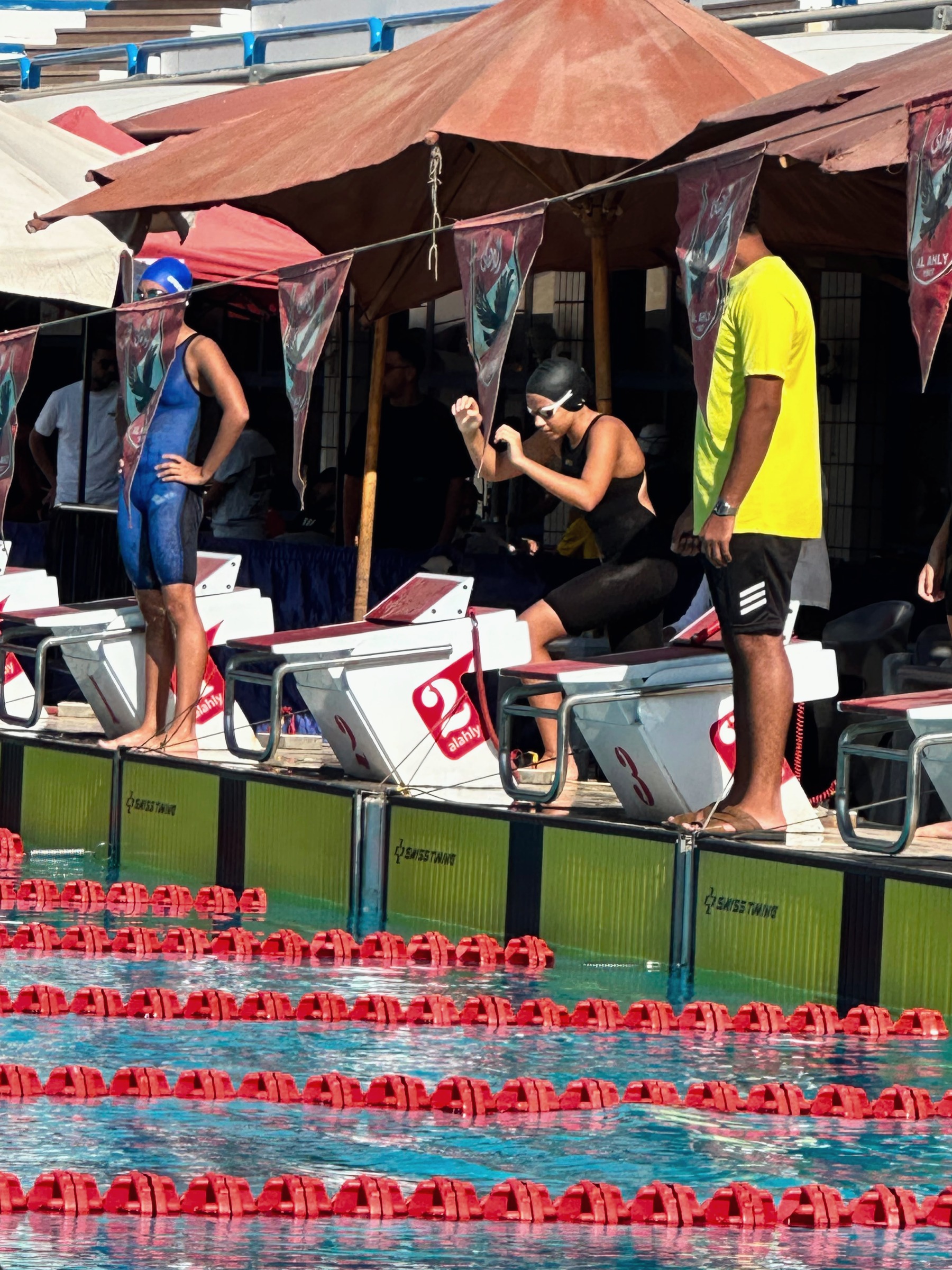
Now hear them on deck.
The vocabulary makes more sense in the water. Your first session is free.